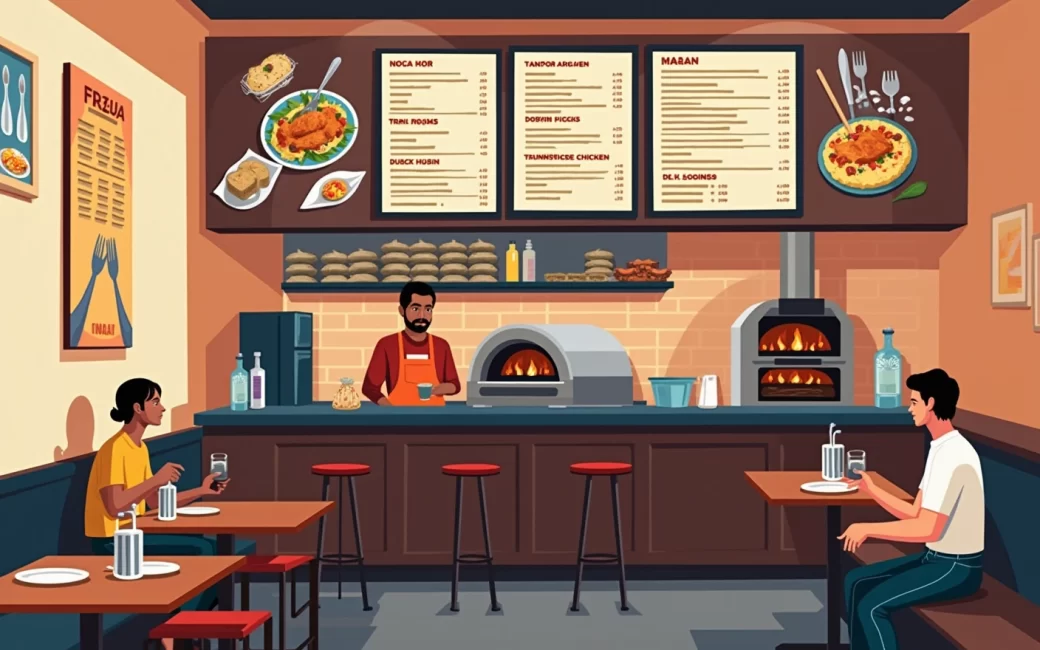
A diner unfamiliar with Indian menus cannot tell dish names apart
A menu that lists rogan josh, saag paneer, and vindaloo side by side offers no clue which is mild, which is a curry, and which is a bread. The confusion clears once the menu is read by cooking method rather than dish name.
Most Indian restaurant menus are organized into three functional groups: items cooked in the tandoor (a clay oven), dishes finished in a masala sauce, and breads. The Indian Food 101 guide walks through this structure specifically so first-time diners can map a name to a category before ordering. Tandoori chicken, seekh kebab, and tandoori shrimp all come from the same oven and share a smoky, charred profile. Anything with "masala," "curry," or a sauce name attached — butter chicken, chana masala, saag paneer — is built on a simmered spice base. Naan, roti, and paratha are the bread category, baked separately from the sauced dishes.
Chicken tikka masala paired with garlic naan is the combination most menus present as the easiest starting point: tandoor-grilled chicken finished in a tomato-based masala sauce, scooped up with bread instead of a fork. Ordering that pair, plus a portion of rice, gives a complete plate without needing to decode the rest of the menu. It also sets a baseline — once a diner knows what "masala" tastes like at medium heat, every other curry on the menu becomes a variation on that same reference point rather than an unknown.
Heat comes from the spice blend, not from the dish category itself
A dish is not "always spicy" because of what it's called — vindaloo can be made mild, and a "mild" korma can be cooked hot if a kitchen chooses to. Heat is added during preparation through the spice blend and chili quantity, which means it's a variable set by the cook, not a fixed property of the dish name.
Because the spice level is applied at cooking time, it can usually be adjusted at the point of ordering — dine-in or online. Restaurants that take online orders, such as Tiffin Indian Cuisine, commonly let a diner specify a heat preference on the same dish a table order would request verbally. Stating a preference — mild, medium, or hot — before the kitchen fires the dish is the mechanism, not a special accommodation.
This matters most for a diner who has avoided Indian food because of a single bad hot experience. The category isn't the problem; the specific batch was. Asking for a dish "mild" doesn't just cool it down — it typically also softens the amount of raw chili relative to the other spices like cumin, coriander, and turmeric, so the dish still carries flavor without the burn. A diner who orders "medium" as a default starting point and adjusts up or down on a second visit learns their own tolerance faster than by guessing from a menu description alone.
Tandoori dishes and naan both come from the same clay oven
Tandoori chicken and naan bread look unrelated on a menu — one is a spiced, grilled meat, the other a bread — but both depend on the same piece of equipment: the tandoor. A restaurant without a functioning tandoor cannot produce either one properly; both dishes need the extreme, direct heat that a tandoor generates.
This gives a practical way to judge a restaurant before ordering. A menu that lists tandoori chicken, tandoori shrimp, and multiple naan varieties (garlic, keema, Peshawari) is signaling that the kitchen runs a tandoor daily, not occasionally. A menu with only one naan option and no tandoori entrées at all may be relying on a conventional oven or a naan supplier rather than baking to order. Menus built around North Indian cooking — the style built on tandoor grilling and masala sauces — tend to show this depth clearly, since the tandoor is central to that regional tradition rather than incidental to it.
Indian restaurant menus assume a regional style most diners don't recognize
Almost every menu described as "Indian food" — tandoori meats, naan, masala curries — represents North Indian cooking specifically, not Indian cuisine as a whole. A diner expecting dosa, idli, or sambar from a South Indian menu will find none of those dishes on a typical North Indian-style menu, because the two regional traditions use different staple grains, cooking methods, and spice bases entirely. Rice and lentil-based fermented preparations dominate South Indian menus, while wheat breads and dairy-heavy sauces dominate North Indian ones. Checking which regional style a restaurant specializes in before visiting avoids the mismatch.
Dietary restrictions are easier to accommodate at an Indian restaurant than the menu implies
Vegetarian, vegan, halal, and gluten-free needs are all workable within a standard Indian menu, though menus rarely spell out which dishes qualify. Paneer and lentil (dal) dishes are vegetarian by default; many can be made vegan by requesting the sauce be prepared with oil instead of ghee or cream. Rice and most curries are naturally gluten-free, while naan and other wheat breads are not — rice or a gluten-free bread substitute covers that gap. Asking directly about halal meat sourcing and vegan substitutions at order time is more reliable than assuming from the printed menu.
Ordering enough food depends on how sharing works, not on per-dish pricing
Indian meals are built for shared eating rather than one dish per person. A workable baseline is one bread, one rice dish, and one curry for every two diners, with an additional curry added for every two more people at the table — adjusted up if tandoori appetizers are also ordered separately. Because bread, rice, and curry are priced and ordered independently rather than bundled into a single entrée, under-ordering any one category is the most common mistake a first-time table makes.
"Authentic" is a claim, not a description — check what it's based on
"Authentic" and "traditional" appear on nearly every Indian restaurant's marketing without criteria attached. A more useful check is whether the kitchen owns a tandoor, offers regional specificity (North vs. South Indian) rather than a generic blended menu, and lists spice-level customization — all signs of a kitchen built around traditional technique rather than a shortened, Americanized version of the cuisine. Judging a menu on those specifics gives a firmer answer than the word "authentic" printed on a sign.
Use the tandoor test, the regional label, and the heat-level question on the next menu in front of you — those three checks tell you more about a kitchen than any review does.